
What is behind that organic label?

An organic certificate is issued in the Netherlands by SKAL and sets a number of minimum requirements for how animals are kept. No synthetic pesticides on the land, part of the feed must be organic, more space per animal than usual, and no preventive use of antibiotics.


These are meaningful requirements, but they are minimum standards. They say something about the system in which an animal lives, not about how that animal actually spends its days. An organic cow can spend most of its life in a barn, be fed organic concentrated feed, and be separated from its mother at a young age. All of this falls within the rules.

Grass-fed is not the same as organic

Grass-fed and organic are often used interchangeably, but they are different things.


Grass-fed means that a cow eats grass its entire life: fresh in the pasture, hay in the winter. No grains, no corn, no concentrated feed. This directly affects the fatty acid composition of the meat, including the levels of omega-3 and CLA.


Organic does not say anything about that. Organic cattle often receive concentrated feed, as long as that feed is organically certified. Conversely, grass-fed cattle do not always have an organic certificate, especially if they graze in natural areas where the land is not certified.

Natural cattle: no certificate, but a story

Native cattle breeds are breeds that have been bred for independence. They live outdoors, in natural areas that are not suitable for conventional farming, and eat what grows there: coarse grass, herbs, thistles. They do not need a barn and hardly any supplementary feed.


Many of these cattle do not have an organic certificate, not because they are inferior, but because certification costs money and paperwork and is often not designed for extensive natural grazing. The system does not always align with the reality of the animal.

Suckling from the mother and living in a herd

In both conventional and organic livestock farming, calves are often taken away from their mothers shortly after birth. The organic certification does not require a minimum nursing period.


With the Maine-Anjou cattle we use, calves stay with their mothers for up to eight months. They grow up in a social herd, with the space that comes with it. This affects the development of the animal, both hormonally and immunologically. A calf that stays with its mother for a long time and grows up in a herd develops differently than a calf that has not had this, and this is ultimately reflected in the quality of the meat and offal.

Stack & Combine up to 
15% extra discount

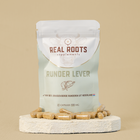
Raw & freeze-dried for optimal possible preservation of nutrients

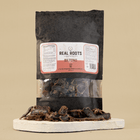
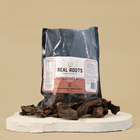
Consists of liver from 100% grass-fed cattle that freely graze on the fertile Dutch meadows.

Rich in, among others, vitamin A, B-complex, B-12, copper, iron, selenium & unique peptides

Supports your energy levels, mental balance, and immune system and is important for the skin and eyesight

Starting from €0.57 per day when using 3 capsules

Liver Capsules

30-day money-back guarantee

Why the story says more than the label

A certificate provides a foundation, but the real questions go further. What did the animal eat? Did it have the space to exhibit normal behavior? Was the calf able to grow up with its mother? These are the questions we ask the farmers we work with. This is how we assess whether a product meets our standard, regardless of what the certificate says.

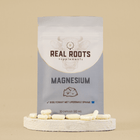
Be sure you get the best Magnesium supplement at home

Real Roots reviews

Fantastic

I have been taking the organ mix, liver, and pancreas for 2 weeks now. Despite the short use, I really feel much fitter. Waking up was always difficult for me, but since I started taking the supplements, I get going right away in the morning and no longer experience energy slumps during the day. 🙏🏼

Sharon v.d.B.

Verified Real Roots User

Very nice!

For a few weeks now, I've been fully back in my routine with capsules and collagen powder in my coffee. Just that alone feels really nice. But I also truly see a difference in my skin. I don't want to be without my new morning routine anymore. What’s also great is that it contains only 1 ingredient, and that's how it should be.

Marit

Verified Real Roots User

Ideal natural skincare

The collagen powder is one I no longer want to be without. I notice the difference in elasticity in my skin and the glow it gets without any other product thanks to the collagen powder.

M.A.

Verified Real Roots User

Delicious bone broth!

I am now enjoying my second Real Roots bone broth pasta jar and I love it! I have already placed a new order <3 I really like that it comes in a glass jar, it tastes delicious, and because of that, I eat or drink it daily.
Thank you!

Daphne

Verified Real Roots User

More information

wwk_logo_sm-64x64 Created with Sketch.

rated 9.9 by 750+ customers

What are you waiting for?
Discover the power of nature today!

Discover the power of nature today!

400+ reviews on Google

For me, the number 1 vitamin C!
 

Camu Camu has truly been a discovery for me. Camu Camu is known for its high natural vitamin C content. I feel more energetic and notice that my immune system is better supported. Since I’m not a fan of loose supplements and pills, I trust Real Roots. It feels good that this product is simply real food and not artificially composed.

Rick H.

Verified Real Roots User

Frequently Asked Questions

We have compiled the most frequently asked questions about oysters for you!

Is organic meat always grass-fed?

No. Organic cattle are allowed to receive concentrated feed, such as grains and corn, as long as that feed is organically certified. Grass-fed and organic are two different certifications with different requirements.

Can meat be grass-fed without an organic certificate?

Yes. Many grass-fed cattle graze in natural areas where the land is not certified. The animal eats only grass, but the certificate is missing because the certification was not designed for that type of grazing.

What does natural beef mean?

A natural cattle is a cow that lives in a natural area and stays outside all year round. It eats what grows naturally and does not need supplementary feed. It is not an official certification, but a description of the way the animal is kept.

Why do natural cattle often not have an organic certificate?

Certification costs money and requires administration. For farmers with small herds in extensive natural areas, this is often not profitable. Moreover, the certification system is mainly designed for more intensive forms of agriculture, making it impossible in most cases.

What is the difference between a herd life and a stable?

Cattle in a herd naturally display social behavior. They have a hierarchy, move freely, and graze at their own pace. In the barn, this behavior is limited. With natural cattle breeds, the animals live outside in groups all year round.
